
Daily Market Commentary Warsh Says Little: Market Hears Hold Blog AI Capex And Earnings: What Happens When Growth Slows Bull Bear Report Pimco Sees A 6% 10-Year. Here’s Why “Bad Inflation” Caps Yields Daily Market Commentary CoreWeave Shares Tumble As Its Debt Flounders Blog Bad Inflation Cures Itself. Good Inflation Doesn’t Daily Market Commentary CPI Hotter Than Expected: Is A Hike Back On The Table? Blog Think Rates Are Peaking? Consider Mortgage-Backed Securities Daily Market Commentary What The NFL Can Teach Us About Risk Management Daily Market Commentary OpenAI Rains On The Tech Parade Blog Bonds At 5%: Is The 10-Year Treasury Finally A Buy?
Vol. XXVII · No. 134
Monday — October 19, 2026
Houston, Texas

Real Investment Advice

— Truth behind the data. Discipline behind the decisions. —

★ Cover Story · This Week

AI capex and earnings are now so tightly tied that spending doesn’t have to fall to hurt profits. It only has to stop accelerating. Almost half of the S&P 500’s earnings growth this year traces back to one activity: companies buying chips, servers, power gear, and concrete to build artificial intelligence. That’s the estimate Goldman […]

— Who We Are

Wall Street has a story. We have the data.

Real Investment Advice is the editorial home of RIA Advisors — a registered investment advisory firm managing client portfolios through every cycle since 1995. We publish what we actually do: the analysis driving real portfolio decisions for real money.

No consensus narratives. No paid placements. No catastrophist click bait. Just disciplined, evidence-driven commentary on markets, the economy, and the policy machinery that moves both — written by the portfolio managers who own the calls.

  • 01 Data Over Dogma
  • 02 Discipline Over Drama
  • 03 Process Over Prediction
— Section 02 · The Feed

Latest Commentary

ALL POSTS
Warsh Says Little: Market Hears Hold Daily Market Commentary
— Daily Market Commentary · 12 hours ago

Warsh Says Little: Market Hears Hold

Kevin Warsh spoke Friday at the IMF annual meetings in Bangkok. He gave little indication of whether the Fed would hold rates or increase them at the coming meeting on October 28. To that end, he said: “I don’t prejudge meetings,” noting at the September meeting the Committee “made very clear that we would deliver […]


RIA Team 7 min read
AI Capex And Earnings: What Happens When Growth Slows Blog
— Blog · 12 hours ago

AI Capex And Earnings: What Happens When Growth Slows

AI capex and earnings are now so tightly tied that spending doesn’t have to fall to hurt profits. It only has to stop accelerating. Almost half of the S&P 500’s earnings growth this year traces back to one activity: companies buying chips, servers, power gear, and concrete to build artificial intelligence. That’s the estimate Goldman […]

Lance Roberts 12 min read
Pimco Sees A 6% 10-Year. Here’s Why “Bad Inflation” Caps Yields Bull Bear Report
— Bull Bear Report · 3 days ago

Pimco Sees A 6% 10-Year. Here’s Why “Bad Inflation” Caps Yields

The market sold off hard to finish the week. The S&P 500 fell 1.09% on Friday to 7,659.44, closing the week down 1.95%, its worst week since June. The Nasdaq Composite fared worse, dropping 2.15% Friday and 4.48% for the week. Meanwhile, the Dow eked out a 0.67% weekly gain, and the Russell 2000 lost 3.05%. That split tells you most of what you need to know about what happened: there was a continued rotation from growth and risk to value and safety.

Lance Roberts 19 min read
CoreWeave Shares Tumble As Its Debt Flounders Daily Market Commentary
— Daily Market Commentary · 3 days ago

CoreWeave Shares Tumble As Its Debt Flounders

CoreWeave shares have fallen by nearly 50% since April, including a 15% decline on Wednesday. More concerning, its 9.625% notes maturing in 2032 traded for less than 80 cents on the dollar. That equates to a yield of nearly 15%. For context, the yield was below 10% earlier this week. Its five-year credit default swap […]

RIA Team 6 min read
— Section 03

Podcasts & Shows

— Section 04

Upcoming Events

  • The Retirement Blueprint In Person Event
    RSVP →
— Section 01 · Everything In One Place

The Resources

VIEW ALL
— Res / 01

Bull Bear Report

Our flagship weekly: technicals, sector positioning, portfolio model updates, and the call that matters most for the week ahead. Roughly 4,000 words. Always closing with: Bottom line.

★ Every Saturday
— Res / 02

Daily Commentary

Morning markets in plain English. What happened, what it means, what to do.

Every Trading Day · 7:30 AM CT
— Res / 03

Blog

Deep dives, contrarian takes, charts of the week.

3-5 / Week
— Res / 04

Podcasts & Shows

Real Investment Show · Q&A Wednesday · 5-Minute Markets.

Weekly & On-Demand
— Res / 05

Events

Speaking engagements, conferences, member meetups.

Live & Virtual
— Res / 06

RIA E-Guide Library

Long-form educational guides on retirement, asset allocation, risk management, and behavioral finance. Free for subscribers — built for serious investors.

24 Guides · Always Growing
— Ask The Archives · Powered by Claude

Ask Anything.

Drawing on 30+ years of
RIA research & analysis

Get answers drawn directly from the Bull Bear Report, Daily Commentary, blog archive, and Lance's long-form research. Cited. Linked. Sourced.

— Popular questions:
— Section 05 · Free For Subscribers

The E-Guide Library

ALL GUIDES
Aging In Place N° 01

Aging In Place

How To Win The Long Game
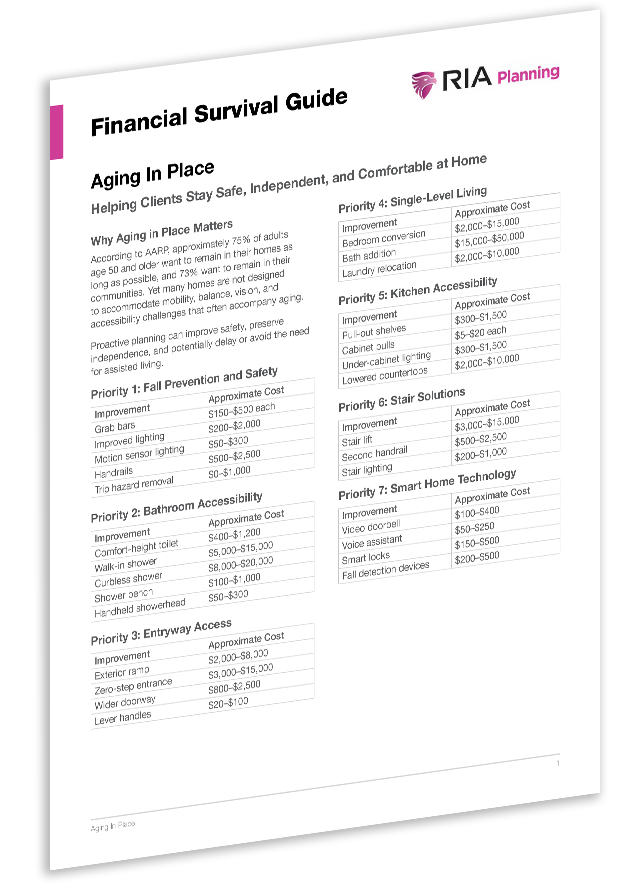
Helping Clients Stay Safe, Independent, and Comfortable at Home. Why Aging in Place Matters.… Download Now
15-Trading Rules To Follow N° 02

15-Trading Rules To Follow

How To Win The Long Game
Risk isn’t about how much money you’ll make . It’s about how much you… Download Now
Designing Compensation for Performance N° 03

Designing Compensation for Performance

Designing Compensation for Performance
Labor is the single largest expense for most organizations, and the scale of that… Download Now
Financial Wellness and Physical Health N° 04

Financial Wellness and Physical Health

The Powerful Connection Between
Financial wellness and physical health are often treated as separate goals—one handled by budgets… Download Now
Section 08 · People Also Ask

Questions, Answered.

The questions investors ask most, answered by the RIA Advisors research team.

Who is Lance Roberts?

Lance Roberts is the Chief Investment Strategist at RIA Advisors and the lead voice behind Real Investment Advice. For more than 30 years he has written about equity markets, Federal Reserve policy, macroeconomic trends, and the behavior that drives investor decisions. He writes the weekly Bull Bear Report and hosts The Real Investment Show, broadcast live weekday mornings. His commentary appears regularly on CNBC, Fox Business and Bloomberg, and he has been cited by the Wall Street Journal, Business Insider and MarketWatch.

His approach starts with managing risk, because the math of loss is unforgiving. Every answer on this page comes from his published research.

Start here: Lance’s essential reading

Do stock market valuations predict future returns?

Over long periods, yes. Over short periods, no. Measures like the Shiller CAPE ratio and market cap to GDP have a strong inverse relationship with the returns of the following decade. High starting valuations have historically led to weak ten-year returns, and low starting valuations to strong ones.

Valuations tell you what you are likely to earn, not when the market will turn. They reflect investor psychology at the moment you buy, which is why they work as a gauge of future returns and fail as a timing tool.

Read: The Best Measure Of Future Stock Market Returns

Why do large losses hurt long-term returns so much?

Gains and losses are not mirror images. A 50% decline requires a 100% gain just to get back to even. A 10% gain followed by a 10% loss still leaves you behind where you started. That “volatility drag” compounds quietly over time.

Timing makes it worse. A large loss early in retirement leaves less capital to recover with, no matter what the long-term average says. Avoiding the big loss does more for long-term wealth than capturing every gain.

Read: Loss: Why Crashes, Timing & Valuations Matter

What are Bob Farrell's 10 rules of investing?

Bob Farrell, the longtime chief market analyst at Merrill Lynch, distilled decades of market history into ten rules. Markets return to the mean. Excesses in one direction lead to excesses in the other. There are no “new eras.” Parabolic moves go further than expected but do not correct by going sideways. The public buys the most at the top and the least at the bottom. Fear and greed beat long-term resolve. Markets are strongest when broad and weakest when narrow. Bear markets have three stages. When all the experts agree, something else tends to happen. Bull markets are more fun than bear markets.

The rules endure because human behavior never changes. Rule #9 is the one to remember when the consensus is loudest.

Read: The Rules Of Bob Farrell, An Updated Illustrated Guide

What really drives interest rates?

Over time, the 10-year Treasury yield tracks the economy. It roughly equals real economic growth plus inflation, a relationship that has held for decades. When growth and inflation run hot, yields rise. When they slow, yields fall.

The popular claim that rising federal debt forces rates higher does not hold up against the data. Japan carries far more debt than the U.S. at far lower yields. Rates follow growth and inflation, not the size of the debt.

read: Rising Interest Rates: Why The Narrative Fails Against The Data

Is U.S. government debt a crisis waiting to happen?

Not in the way the “doom crowd” suggests. A government that borrows in its own currency cannot be forced into default like a household, or like Weimar Germany paying debts in foreign currency. Every dollar of government debt is also a dollar of private-sector savings.

The real cost is slower. Rising interest payments and unproductive spending crowd out private investment and weigh on economic growth. The risk is not collapse. It is a long, slow drag on growth. Such is the true price of debt.

Read: Government Debt: Not What The Doom Crowd Thinks It Is

Does money printing cause inflation?

The “money printing” story misreads how money is created. In the modern banking system, loans create deposits, so the money supply largely grows with economic activity. Inflation depends on how fast money moves through the economy, its velocity, as much as on how much of it exists.

Money supply growth alone does not cause inflation. That is why deficits by themselves are a poor reason to abandon productive assets for gold or bitcoin. Hard assets can diversify a portfolio, but their prices hinge on the dollar and real interest rates.

Read: Money Supply Growth: A Thesis With A Fatal Flaw

Why do most investors underperform the market?

The biggest gap between market returns and investor returns is behavior. Confirmation bias, herd behavior, anchoring to past events, and chasing recent winners lead investors to buy after big gains and sell after big losses.

Most investors do not lose to the market. They lose to themselves. A written plan and clear rules for managing risk do more to close that gap than finding the next hot stock.

Read: Behavioral Traits That Are Killing Your Portfolio Returns

— Join 250,000+ Subscribers

Get the work before Wall Street does.

The Daily Market Commentary and Bull Bear Report — delivered free, every trading day and every Saturday. No spam. No paywall on the analysis. Unsubscribe in one click.

Name(Required)

By subscribing you agree to receive RIA editorial content. We never sell or share your data.